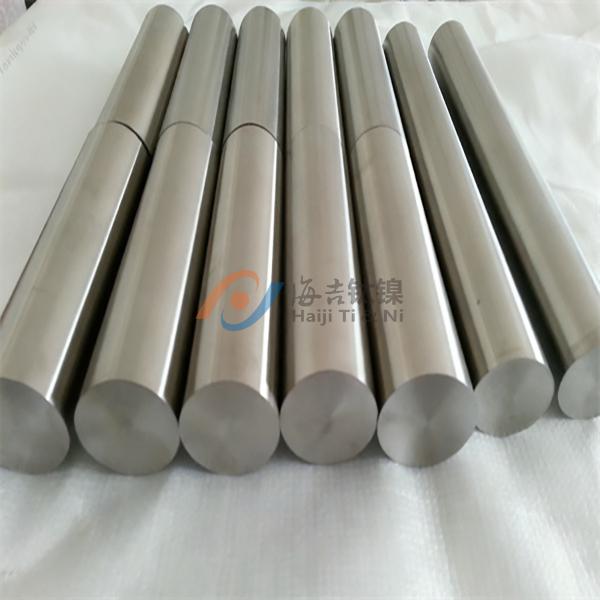
titanium rod
1. Key specifications and supply form1. Basic specificationsDiameter: 3mm to 300mm (thin rod); 300mm to 600mm (thick rod/forged rod)Length: cut-to-length 2m/3m/6m, supports on-demand cutting; non-stan...
Product Introduction
1. Key specifications and supply form
1. Basic specifications
Diameter: 3mm to 300mm (thin rod); 300mm to 600mm (thick rod/forged rod)
Length: cut-to-length 2m/3m/6m, supports on-demand cutting; non-standard lengths can be customized
Surface condition:
Hot-rolled black sheet (low cost, for rough machining)
Polishing (Ra≤1.6μm)
Mirror finish / Electrolytic polishing (electrode, decoration)
Supply status: Soft (M, easy to bend/cut), semi-hard (Y2), hard (Y), hot-worked (R)
2. Core implementation standards
Material standards: GB/T 2965 (Titanium and Titanium Alloy Bars), ASTM B348
Performance standards: GB/T 3098.16 (Mechanical Properties of Titanium Fasteners), GJB 2219 for aviation use
II. Manufacturing Process and Quality Control
Melting: Vacuum induction/electron beam melting, strictly controlling carbon, sulfur, and phosphorus impurities to ensure purity and density;
Hot processing: TC4 requires die forging to refine grain size and eliminate casting porosity; TA2 is often hot rolled for cogging;
Finishing process: multiple drawing/turning processes + intermediate annealing (to eliminate work hardening), controlling concentricity and roundness;
Detection
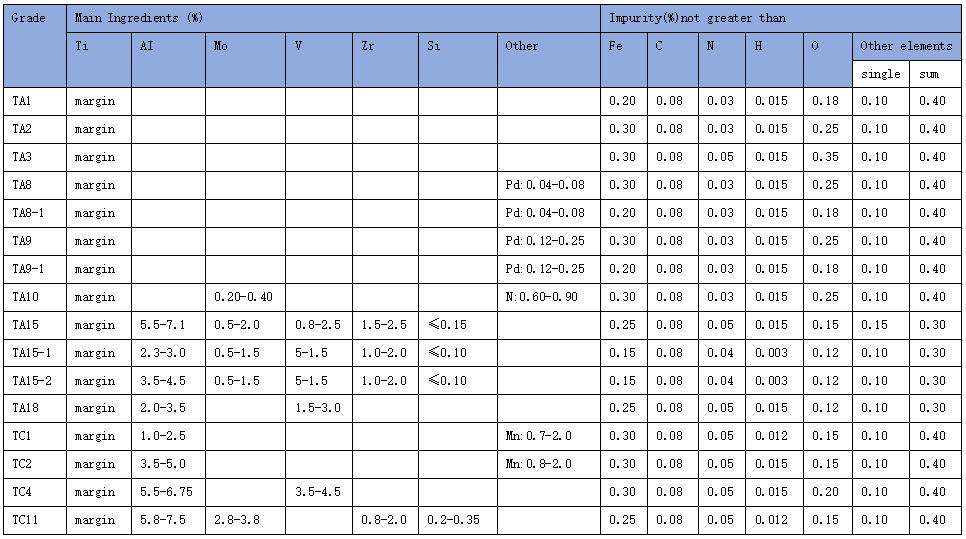
Chemical composition: Spectral analysis, matching grade;
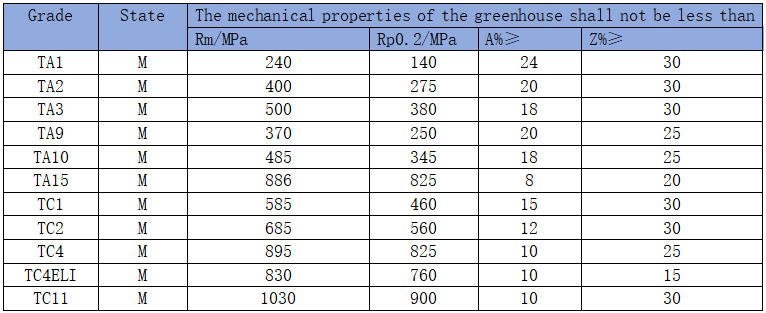
Mechanical properties: Tensile strength, yield strength, and elongation meet the standards;
Non-destructive testing: Ultrasonic Testing (UT) for detecting internal defects, and Penetrant Testing (PT) for identifying surface cracks;
Dimensional accuracy: Go/no-go gauge is used to inspect diameter and length, with a tolerance of up to ±0.01mm.
Chemical composition of titanium and titanium alloys
Greenhouse mechanical properties of bar materials